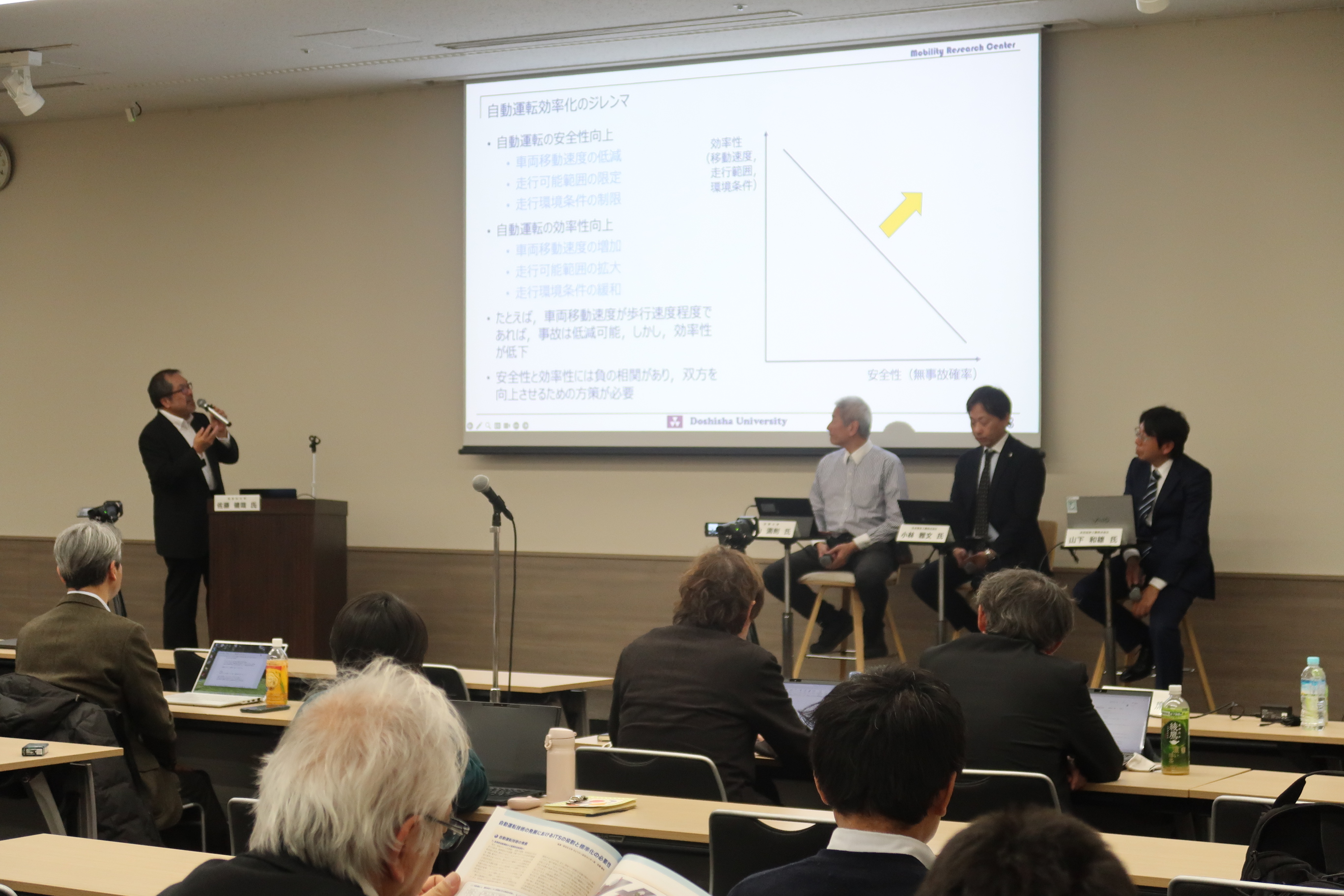
International Journal of Intelligent Transportation Systems Research に,松本翔汰(M2)と梅田寛斗(M2)の論文が掲載されました.
Considerations on the Impact of Communication Delays on Safety in Cooperative Automated Driving
Shota Matsumoto, Onur Alparslan & Kenya Sato
In recent years, research on cooperative automated driving has achieved significant advancements. Vehicle-to-vehicle (V2V) communication enables the sharing of information among vehicles, which is expected to mitigate traffic accidents and optimize traffic flow. In this study, we quantitatively evaluated the impact of communication delays on safety by simulating a scenario in which a connected vehicle performs an emergency stop and lane change on a highway. The analysis revealed that as communication delays increase, vehicles must decelerate more abruptly, elevating the risk of failing to meet established safety standards. Conversely, extending the communication range was found to reduce the frequency of sudden deceleration events. These findings suggest that optimizing both the timing and range of communication is essential to ensure the safety and efficiency of automated driving involving multiple vehicles operating in coordination. This contributes to enhancing both safety and efficiency in intelligent mobility systems.
DOI: https://doi.org/10.1007/s13177-025-00594-6
Evaluation of Collaborative Merging Methods for Connected Vehicle Using Spatio-temporal Grid Reservation
Hiroto Umeda, Alparslan Onur & Kenya Sato

Spatio-temporal grid reservation has been studied as an efficient coordination framework for connected and automated driving, where each vehicle reserves its intended time and space through a dynamic map server. Although a previous study applied this framework to highway merging, it was evaluated in a simplified environment that did not consider lane changes on the mainline. In this study, we implement the spatio-temporal grid reservation framework on a dynamic-map–based system and extend the merging coordination mechanism to incorporate lane changes. By enabling mainline vehicles to change lanes in advance when the merge point is predicted to be occupied, the system leverages wide-area traffic information to alleviate congestion near the merging area. Simulation results show that this extension reduces travel time delay and decreases the frequency of sudden deceleration events, indicating improved efficiency and safety in highway merging coordination.